
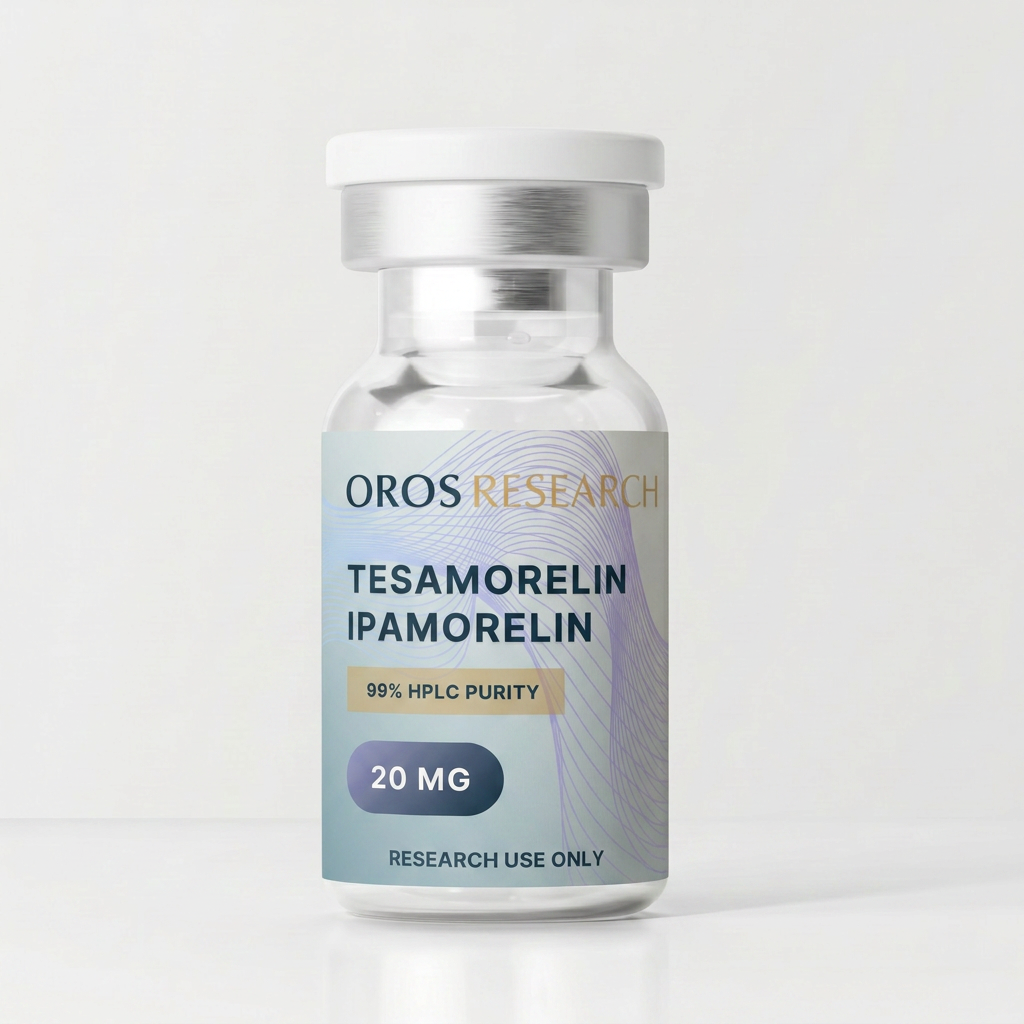
Tesamorelin 16mg / Ipamorelin 4mg (20mg Blend)
$129.99
- Contents: Tesamorelin 16mg / Ipamorelin 4mg
- Total Net Weight: 20 mg
- Vial Size: 3 mL
- Research Classification: Dual-peptide research blend
- Research Context: GHRH and growth-hormone secretagogue signaling research
- Laboratory Solution Compatibility: Do not use sodium chloride solutions with this research material
- For in-vitro laboratory preparation, use OROS Reconstitution Solution or another solvent independently validated by your laboratory
- Research Use Only: Not intended for human or animal use
Tesamorelin Ipamorelin 20mg Blend – Advanced Peptide Research
Tesamorelin ipamorelin is a dual-peptide research formulation containing 16mg of tesamorelin and 4mg of ipamorelin, providing a total net weight of 20mg in a 3mL vial. The formulation combines two chemically and pharmacologically distinct research peptides associated with different aspects of growth-hormone signaling research.
Tesamorelin is a synthetic analogue of growth hormone-releasing hormone (GHRH), while ipamorelin is a pentapeptide growth-hormone secretagogue investigated through GHS receptor-related pathways. This distinction makes the blend relevant to controlled laboratory research examining how separate signaling mechanisms may be evaluated within the same experimental system.
OROS Research supplies this formulation exclusively for qualified laboratory and in-vitro investigation.
Tesamorelin Ipamorelin Research Overview
Tesamorelin ipamorelin combines two research compounds that should not be considered interchangeable.
Tesamorelin has been investigated as a synthetic GHRH analogue. GHRH receptor activation is associated with adenylyl cyclase activity and intracellular cAMP signaling in experimental models.
Ipamorelin, by contrast, was developed as a selective growth-hormone secretagogue. Experimental studies have characterized it as a pentapeptide and investigated its interaction with a GHRP-like receptor pathway.
This difference provides an important basis for research involving tesamorelin and ipamorelin. Rather than representing two versions of the same peptide, the compounds provide distinct molecular approaches for studying growth-hormone-associated signaling.
Researchers can explore chemical records through the PubChem chemical database and locate peer-reviewed experimental literature through the PubMed biomedical research database.
Tesamorelin and Ipamorelin Signaling Research
The combination provides a useful framework for laboratory investigation because GHRH receptor signaling and growth-hormone secretagogue receptor signaling involve different receptor systems.
Experimental research has shown that GHRH receptor activation can stimulate adenylyl cyclase and increase intracellular cAMP. Growth-hormone secretagogues act through a distinct G-protein-coupled receptor system involving different downstream signaling mechanisms.
Cellular studies have also investigated interactions between these pathways, including how growth-hormone secretagogue signaling can influence responses generated through GHRH receptors.
This research context makes the 16mg/4mg formulation relevant to experimental designs examining receptor signaling, pathway interactions, and comparative peptide activity.
It does not establish that combining these peptides produces a specific therapeutic or performance outcome in humans.
Tesamorelin vs Ipamorelin
The search comparison tesamorelin vs ipamorelin reflects two compounds with different molecular classifications and research mechanisms.
Tesamorelin is studied primarily as a synthetic GHRH analogue. Its research context centers on GHRH receptor signaling and downstream growth-hormone-associated pathways.
Ipamorelin is classified as a growth-hormone secretagogue. Published experimental research describes it as a pentapeptide acting through a GHRP/GHS receptor-related mechanism.
Therefore, the principal laboratory distinction is the signaling pathway being investigated, rather than one compound simply being a stronger version of the other.
The reverse comparison, ipamorelin vs tesamorelin, leads to the same scientific distinction: each compound represents a separate research mechanism and should be characterized accordingly.
Laboratory Research Applications
This dual-peptide formulation may be relevant to controlled research involving:
- GHRH receptor signaling studies
- Growth-hormone secretagogue receptor research
- Comparative receptor pathway investigation
- Peptide-receptor interaction studies
- Cellular signaling assays
- GHRH/GHS pathway interaction models
- Structure-function research
- Comparative peptide analysis
- Experimental endocrine-signaling models
Researchers investigating substantially different multi-peptide formulations may separately examine AURA – GHK-Cu / Epithalon / Snap-8 / KPV.
OROS Research also provides individual research materials such as BPC-157 5mg and BPC-157 10mg for separate laboratory investigations.
These products contain different compounds and should not be considered equivalent to the Tesamorelin/Ipamorelin formulation.
Product Specifications
| Specification | Product Information |
|---|---|
| Product | Tesamorelin / Ipamorelin Blend |
| Tesamorelin Content | 16 mg |
| Ipamorelin Content | 4 mg |
| Total Net Weight | 20 mg |
| Vial Size | 3 mL |
| Formulation Type | Dual-peptide research blend |
| Research Context | GHRH and GHS signaling research |
| Laboratory Solution Compatibility | Do not use sodium chloride solutions |
| Intended Use | Laboratory and in-vitro research only |
Laboratory Solution Compatibility
Do not use sodium chloride solutions with this research material.
For in-vitro laboratory preparation, researchers should use the OROS solution linked above or another solvent independently validated by their laboratory for the applicable research protocol.
This compatibility information applies exclusively to laboratory preparation. It is not a reconstitution protocol for personal administration and does not provide injection, dosing, or clinical instructions.
Research Context of the 16mg / 4mg Blend
The formulation contains an 80:20 composition by stated mass, with 16mg of tesamorelin and 4mg of ipamorelin.
For laboratory researchers, having both compounds in a defined formulation enables experimental evaluation of a dual-peptide system without implying that the compounds share identical mechanisms.
Studies involving GHRH and growth-hormone secretagogues have demonstrated that their respective receptor pathways can produce different intracellular signaling responses. This distinction should remain central when interpreting results obtained from experiments involving the blend.
Experimental outcomes may depend on the cell system, assay design, analytical endpoint, experimental conditions, and other protocol-specific variables.
Tesamorelin Ipamorelin FAQ
What is tesamorelin ipamorelin?
Tesamorelin ipamorelin refers here to an OROS Research dual-peptide formulation containing 16mg of tesamorelin and 4mg of ipamorelin. The compounds represent distinct peptide signaling systems and are supplied together for controlled laboratory and in-vitro investigation.
What is the difference between tesamorelin and ipamorelin?
Tesamorelin is a synthetic GHRH analogue associated with GHRH receptor signaling. Ipamorelin is a pentapeptide growth-hormone secretagogue investigated through a GHS receptor-related pathway. Their different receptor mechanisms are an important distinction in comparative laboratory research.
What does tesamorelin vs ipamorelin mean for researchers?
For laboratory research, the comparison primarily concerns their different molecular signaling mechanisms. Tesamorelin represents a GHRH-related research pathway, whereas ipamorelin represents growth-hormone secretagogue signaling. Neither should automatically be treated as experimentally equivalent to the other.
How much of each peptide does the blend contain?
The formulation contains 16mg of tesamorelin and 4mg of ipamorelin, for a total net weight of 20mg. The research material is supplied in a 3mL vial.
What is the tesamorelin cost?
Tesamorelin cost can vary according to product quantity, formulation, and supplier. No price has been included in the supplied product specifications for this page, so researchers should refer to the current OROS Research product listing for applicable pricing rather than relying on an unsupported figure.
Can sodium chloride solution be used with this blend?
No. According to the supplied product specifications, sodium chloride solutions should not be used with this research material. Laboratories should use the specified OROS research solution or another solvent independently validated for their applicable in-vitro protocol.
Is this blend intended for human use?
No. The formulation is supplied strictly for laboratory and in-vitro research. It is not intended for human or animal consumption, injection, therapeutic use, diagnosis, bodybuilding, performance enhancement, self-administration, or veterinary applications.
Research Use Disclaimer
This 20mg dual-peptide formulation is supplied exclusively for controlled laboratory investigation, analytical evaluation, and in-vitro experimentation. It is not intended for human or animal consumption, clinical application, therapeutic use, injection, diagnosis, bodybuilding, performance enhancement, or self-administration. Experimental evaluation should be conducted by qualified researchers according to appropriately validated laboratory procedures.
Related products



Reviews
There are no reviews yet.