
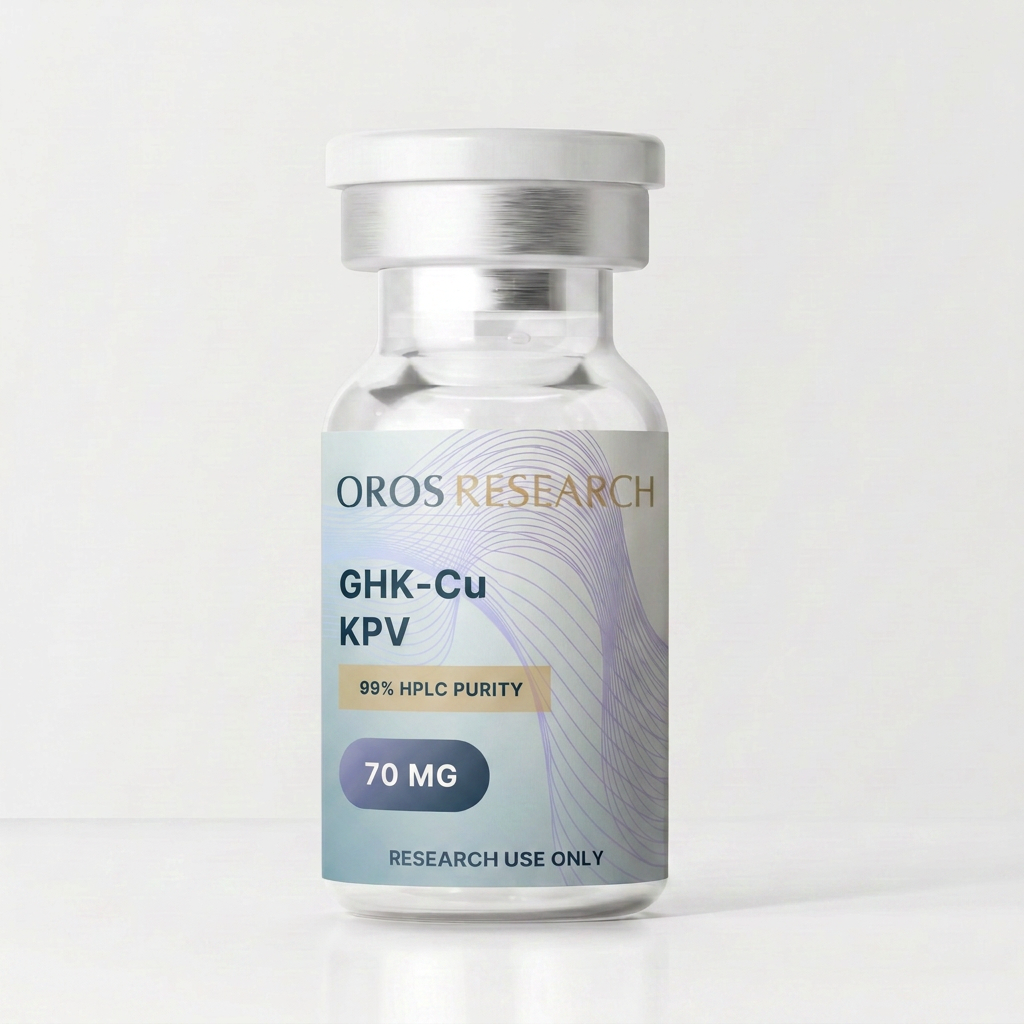
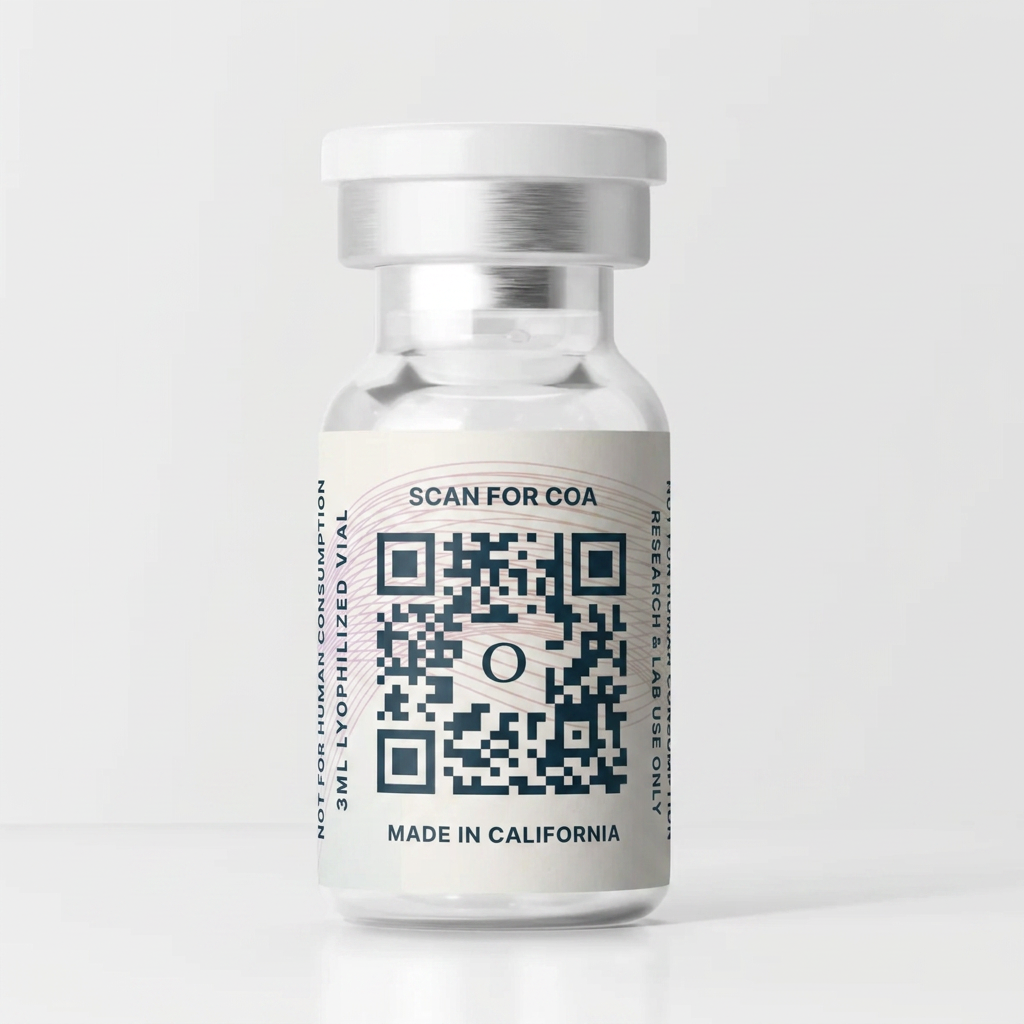
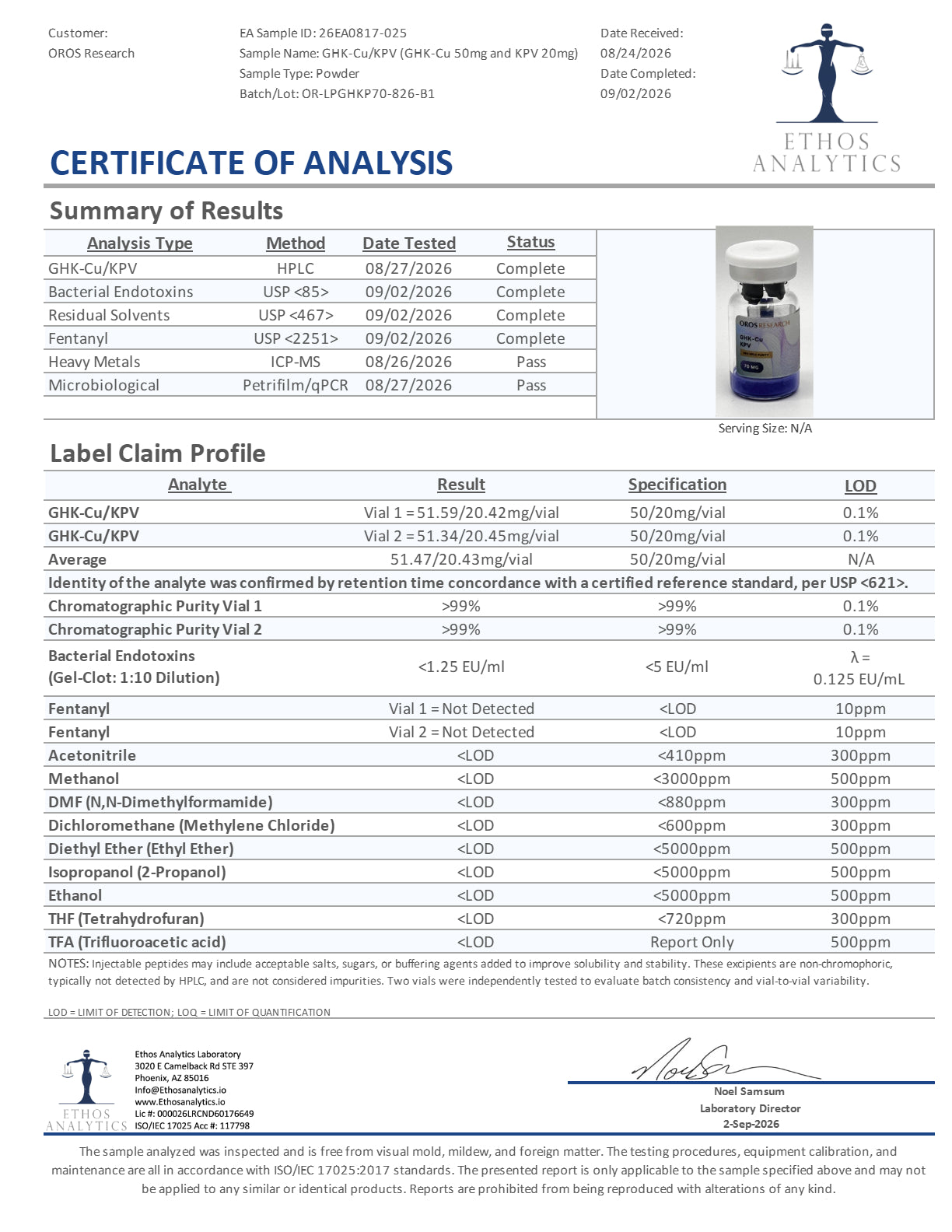
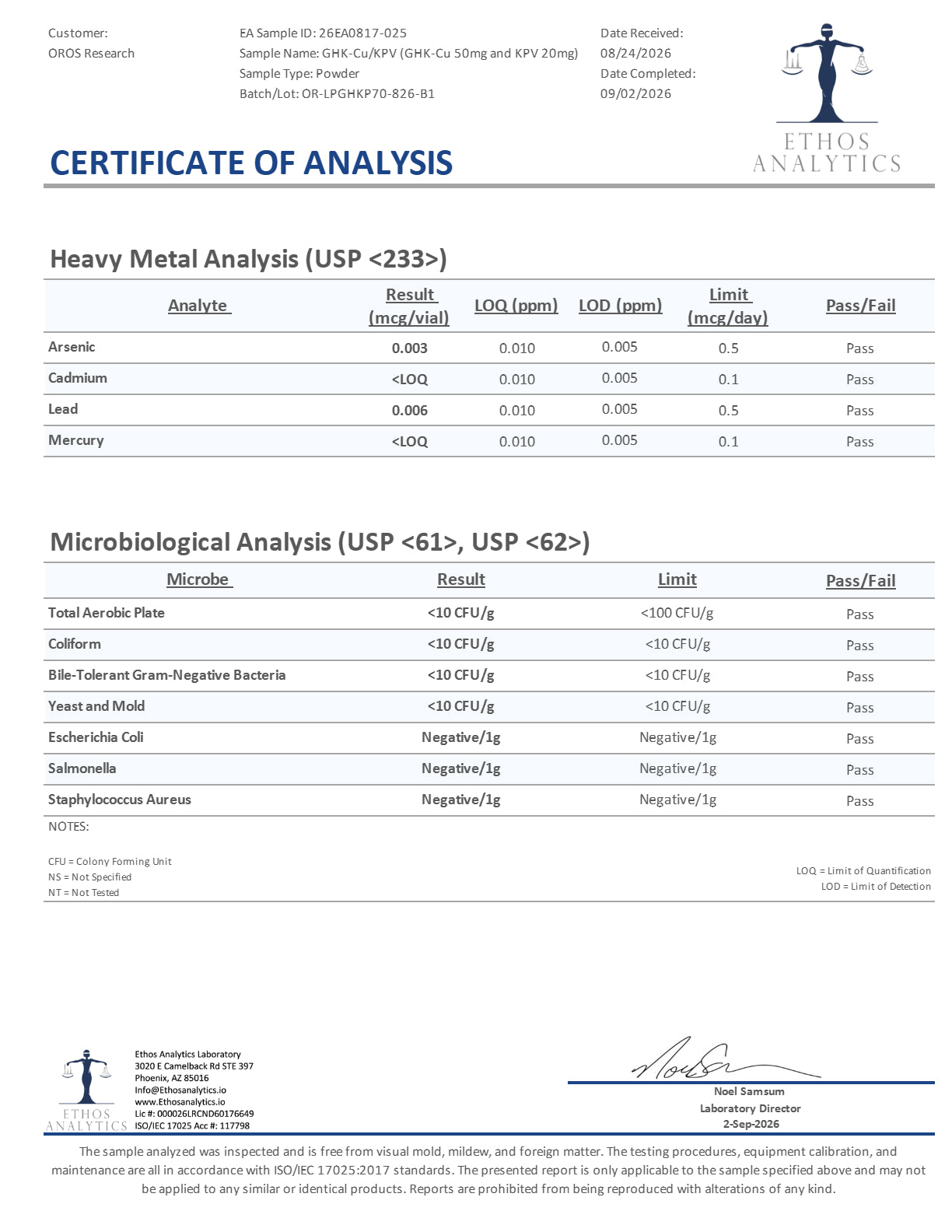
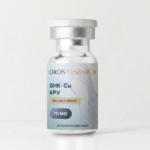
GHK Cu 50mg, KPV 20mg (70mg Blend)
$89.99
- GHK-Cu: 50mg
- KPV: 20mg
- Total Listed Material: 70mg
- GHK-Cu Sequence: Gly-His-Lys
- KPV Sequence: Lys-Pro-Val
- Vial Size: 5mL
- Format: Multi-component research blend
- Intended Use: Controlled laboratory research only
50 in stock
GHK-Cu 50mg / KPV 20mg – Advanced 70mg Research Blend
GHK-Cu 50mg / KPV 20mg is a two-component research blend containing a total of 70mg of specified material in a 5mL vial. The formulation combines the supplied GHK-Cu sequence Gly-His-Lys with the KPV sequence Lys-Pro-Val.
Each component has its own molecular formula, molecular weight, molecular identifiers, and CAS number. Researchers should therefore document and evaluate the two materials independently when comparing this blend with scientific databases or published literature.
GHK-Cu 50mg / KPV 20mg Research Blend
This GHK-Cu research formulation contains two separately characterized components:
| Component | Amount | Sequence | Molecular Weight |
|---|---|---|---|
| GHK-Cu | 50mg | Gly-His-Lys | 340.384 g/mol |
| KPV | 20mg | Lys-Pro-Val | 342.43 g/mol |
| Total | 70mg | — | — |
The total listed quantity is calculated from the two supplied component amounts:
50mg GHK-Cu + 20mg KPV = 70mg total material.
Because this is a blend, the complete formulation should not be assigned one molecular formula or molecular weight.
GHK-Cu 50mg Molecular Specifications
The primary component is GHK-Cu 50mg.
The supplied sequence is:
Gly-His-Lys
Additional molecular specifications include:
- Molecular Formula: C14H23CuN6O4
- Molecular Weight: 340.384 g/mol
- PubChem CID: 73587
- CAS Number: 89030-95-5
Researchers can explore the supplied formula using the PubChem GHK-Cu molecular formula search.
These molecular characteristics provide useful reference points for laboratory documentation and comparison with appropriately matched scientific resources.
GHK Cu Research and Identification
The alternative search spelling ghk cu refers to the primary material without the hyphen.
For research documentation, the molecular identifiers provide greater precision than differences in keyword formatting.
The supplied PubChem CID for this component is 73587, while its CAS number is 89030-95-5.
Researchers reviewing publications should confirm that the sequence, molecular formula, molecular weight, and other relevant identifiers correspond to the exact material used in their experimental work.
KPV 20mg Molecular Specifications
KPV represents the second component and is supplied at 20mg.
The provided sequence is:
Lys-Pro-Val
Additional supplied specifications include:
- Molecular Formula: C₁₆H₃₀N₄O₄
- Molecular Weight: 342.43 g/mol
- Supplied PubChem CID: 125672
- CAS Number: 67727-97-3
PubChem note: The supplied product information identifies KPV as PubChem CID 125672, while the provided hyperlink points to compound 56841945. Because these references conflict, the linked record should not be treated as confirmation of the supplied CID without independent verification.
GHK-Cu and KPV Multi-Component Research
Combining GHK-Cu and KPV within one research vial creates a multi-component formulation rather than a new single molecular entity.
This distinction matters when interpreting scientific evidence.
A publication involving isolated GHK-Cu should not automatically be interpreted as evidence concerning the 50mg/20mg blend. Similarly, findings involving isolated KPV do not necessarily describe observations involving the complete formulation.
Controlled combination research should account for the identity and quantity of both components.
KPV Peptide Dosage Chart – Research Context
The phrase kpv peptide dosage chart reflects search interest concerning quantities and dosing.
This product page does not provide a human dosage chart, injection schedule, treatment protocol, or self-administration instructions.
For laboratory research, the relevant quantities supplied with this product are:
- KPV: 20mg per vial
- GHK-Cu: 50mg per vial
- Combined listed material: 70mg
- Vial capacity: 5mL
These are product specifications rather than recommended administration amounts.
Experimental concentrations should be independently established according to the research model, methodology, controls, analytical requirements, and study objectives.
GHK-Cu Molecular Research Documentation
Accurate documentation is particularly important when GHK-Cu is investigated as part of a multi-component formulation.
Laboratory records may include:
- Compound identity
- Supplied sequence
- Molecular formula
- Molecular weight
- PubChem identifier
- CAS number
- Quantity of each component
- Total material quantity
- Vial capacity
- Experimental concentration
- Research model
- Analytical methodology
- Experimental endpoints
Documenting each component separately helps distinguish experiments involving the complete blend from those involving isolated materials.
70mg Research Blend and 5mL Vial
The supplied formulation contains 70mg total listed material in a 5mL vial.
GHK-Cu accounts for 50mg of the total, while KPV accounts for the remaining 20mg.
The product quantity and vial capacity are useful characteristics for laboratory inventory and experimental documentation.
They should not be interpreted as establishing a recommended dose, concentration, injection volume, treatment amount, or administration schedule.
Laboratory Research Considerations
Controlled investigation involving this GHK-Cu / KPV formulation should use appropriately defined methodology and experimental controls.
Relevant considerations may include:
- Identity of both components
- Experimental concentration
- Research model selection
- Appropriate controls
- Sample preparation
- Exposure conditions
- Analytical methodology
- Experimental endpoints
- Potential multi-component interactions
- Reproducibility
- Data interpretation
Experimental observations should remain tied to the conditions under which they were generated.
Evidence from different models or populations should also be distinguished rather than treated as directly interchangeable.
Research Interpretation for a Two-Component Blend
Research involving a combination requires careful interpretation because the complete formulation contains two separately identified materials.
Researchers should verify whether a scientific publication examines:
- GHK-Cu independently
- KPV independently
- A combination of the two
- A different multi-component formulation
The concentration, experimental model, controls, methodology, and endpoints should also be compared before relating published findings to another laboratory experiment.
This approach reduces the risk of attributing observations from one material directly to a different formulation.
Related OROS Research Materials
Researchers exploring additional peptide research materials can review TB-500 (TB4) 10mg as a separately specified product.
A different quantity is available as TB-500 (TB4) 5mg.
Researchers can also explore Tesamorelin 10mg as another independently characterized research material.
These products have separate compositions and should not be interpreted as chemically or experimentally interchangeable with the GHK-Cu / KPV blend.
Scientific Research Resources
Researchers can use PubChem to investigate available chemical records, molecular identifiers, and compound information.
Peer-reviewed biomedical and experimental literature can be searched through PubMed.
When reviewing scientific publications, researchers should verify the exact material, molecular identity, research model, methodology, controls, and endpoints described in the study.
GHK-Cu / KPV Research FAQ
What is GHK-Cu 50mg / KPV 20mg?
It is a two-component research blend containing 50mg of GHK-Cu and 20mg of KPV in a 5mL vial.
How much total material is supplied?
The two listed components provide 70mg total research material.
What is the GHK-Cu sequence?
The supplied sequence is Gly-His-Lys.
What is the KPV sequence?
The supplied sequence is Lys-Pro-Val.
What is the molecular weight of GHK-Cu?
The supplied molecular weight is 340.384 g/mol.
What is the molecular weight of KPV?
The supplied molecular weight is 342.43 g/mol.
Is there a KPV peptide dosage chart for this product?
No human dosage chart is provided. The 20mg specification describes the amount of KPV contained in the research vial, not a recommended administration amount.
What size vial is supplied?
The blend is supplied in a 5mL vial.
Research Use Disclaimer
This GHK-Cu / KPV blend is supplied exclusively for controlled laboratory investigation, analytical evaluation, and applicable in-vitro research. It is not intended for human or animal consumption, injection, therapeutic application, diagnosis, clinical use, self-administration, cosmetic treatment, bodybuilding, performance enhancement, or veterinary application. Experimental work should be performed by qualified personnel using appropriately validated laboratory procedures.
| Net Weight |
70mg |
|---|---|
| Brand |
OROS Research |
| Format |
Lyophilized Vial |
Related products



Reviews
There are no reviews yet.