
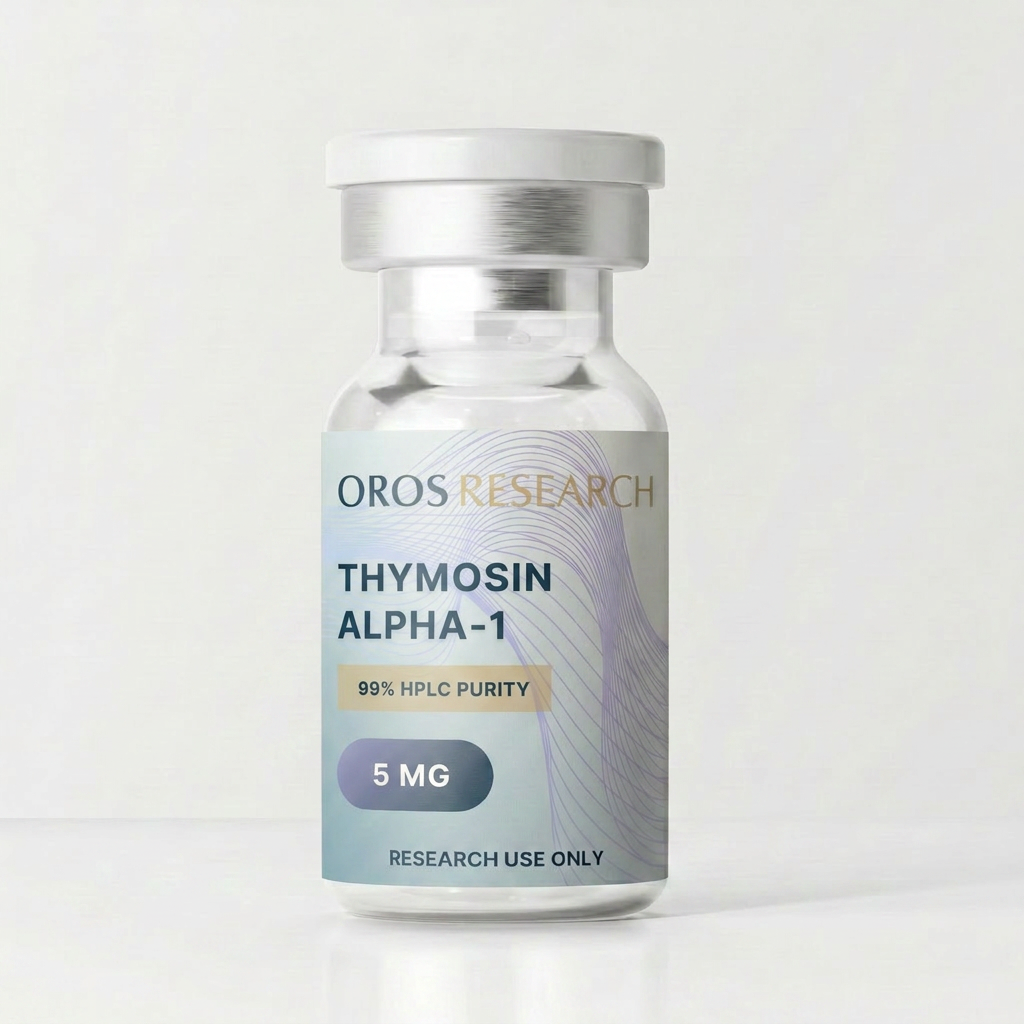
Thymosin Alpha-1 5mg
$39.99
- Compound: Thymosin Alpha-1 5mg
- Research classification: 28-amino-acid peptide
- Sequence: Ac-Ser-Asp-Ala-Ala-Val-Asp-Thr-Ser-Ser-Glu-Ile-Thr-Thr-Lys-Asp-Leu-Lys-Glu-Lys-Lys-Glu-Val-Val-Glu-Glu-Ala-Glu-Asn
- Molecular Formula: C₁₂₉H₂₁₅N₃₃O₅₅
- Molecular Weight: 3108.3 g/mol
- CAS Number: 62304-98-7
- Vial Size: 3 mL
- Research Use: Thymosin alpha 1 material supplied strictly for laboratory and in-vitro investigation; not for human or animal use
Thymosin Alpha 1 5mg – Advanced Peptide for Laboratory Research
Thymosin alpha 1 is a 28-amino-acid peptide that has been investigated extensively in molecular, cellular, and immunological research. Also abbreviated Tα1, the peptide is associated with experimental studies examining immune-cell signaling, Toll-like receptor pathways, dendritic-cell activity, and interactions between innate and adaptive immune processes.
OROS Research supplies Thymosin Alpha-1 5mg in a 3 mL vial for qualified laboratory investigation. Its defined 28-residue sequence and extensive scientific research history make it relevant to controlled experiments involving peptide signaling, molecular interactions, cellular responses, and comparative peptide biology.
Published literature describes Tα1 as an N-terminally acetylated peptide. Research involving this compound should be interpreted according to the experimental model and methodology used rather than extrapolated into personal-use outcomes.
Thymosin Alpha 1 Research Overview
Thymosin alpha 1 was originally identified through research involving thymic peptides and has subsequently become the subject of extensive biochemical and immunological investigation.
The molecule consists of 28 amino-acid residues and has an acetylated serine at its N-terminus. Experimental research has examined how Tα1 interacts with different components of immune signaling and cellular regulation.
Researchers interested in chemical and substance records can consult the supplied PubChem compound record as well as the broader PubChem chemical database.
For peer-reviewed studies concerning Tα1, immune signaling, cellular models, and related experimental research, the PubMed biomedical literature database provides access to published scientific literature.
Thymosin Alpha-1 and Molecular Research
Thymosin alpha-1 has been examined across experimental models involving both innate and adaptive immune processes. Research has investigated its relationship with dendritic cells, macrophages, T cells, B cells, natural killer cells, and other components of immune signaling.
A significant research area concerns Toll-like receptors. Experimental studies have associated Tα1 with several TLR pathways, including TLR2, TLR3, TLR4, TLR7, and TLR9. Downstream pathways investigated in this context include NF-κB, IRF3, MyD88, and related signaling systems.
These findings make the peptide relevant to researchers investigating how short biological signaling molecules interact with complex cellular regulatory networks.
They should not, however, be interpreted as evidence that this OROS Research material is intended to diagnose, prevent, or treat any medical condition.
Laboratory Research Applications
The thymosin alpha 1 peptide may be investigated in appropriately designed laboratory models involving:
- Peptide signaling and molecular interaction studies
- Toll-like receptor pathway research
- Dendritic-cell experimental models
- Innate and adaptive immune-signaling research
- Cellular response assays
- Peptide structure-function investigations
- Comparative peptide research
- Molecular pathway analysis
- Experimental immunology models
Researchers comparing distinct peptide systems may also examine Vesugen 20mg, a KED tripeptide research material.
Another related laboratory material is Vilon 20mg, which can be evaluated independently in comparative short-peptide research.
The dedicated OROS Research Thymosin Alpha-1 5mg product provides the corresponding product reference for this research material.
These compounds should be considered separate research materials. Their inclusion here does not imply equivalent structures, mechanisms, or experimental functions.
Research Context of Thymosin
Thymosin is a broader term associated with thymic peptide research, and individual thymosin-related compounds should not automatically be treated as chemically identical.
Tα1 is specifically characterized as a 28-residue peptide. Research has examined its effects on immune-cell signaling and its interactions with molecular pathways involved in immune regulation. Studies involving dendritic cells have also investigated TLR/MyD88-dependent signaling and other downstream pathways.
The alternative search phrase thymogen alpha 1 may sometimes appear when researchers look for this subject online. However, the compound specified on this page is Thymosin Alpha-1, and the supplied product specifications should be used when identifying the OROS Research material.
Product Specifications
| Specification | Product Information |
|---|---|
| Product Name | Thymosin Alpha-1 5mg |
| Compound | Thymosin Alpha-1 |
| Quantity | 5 mg |
| Sequence | Ac-Ser-Asp-Ala-Ala-Val-Asp-Thr-Ser-Ser-Glu-Ile-Thr-Thr-Lys-Asp-Leu-Lys-Glu-Lys-Lys-Glu-Val-Val-Glu-Glu-Ala-Glu-Asn |
| Peptide Length | 28 amino acids |
| Molecular Formula | C₁₂₉H₂₁₅N₃₃O₅₅ |
| Molecular Weight | 3108.3 g/mol |
| CAS Number | 62304-98-7 |
| PubChem CID Supplied | 16130571 |
| Vial Size | 3 mL |
| Research Classification | Peptide research material |
| Intended Use | Laboratory and in-vitro research only |
Research Significance of the Thymosin Alpha 1 Peptide
The research significance of the thymosin alpha 1 peptide comes from the breadth of experimental work surrounding its molecular and cellular activity.
Studies have investigated Tα1 in relation to dendritic-cell signaling and Toll-like receptor pathways. Other research has examined interactions involving T cells, B cells, macrophages, and natural killer cells. These findings provide multiple experimental directions for researchers examining peptide-mediated cellular regulation.
Importantly, published observations can depend substantially on the specific cell type, experimental system, concentration, methodology, and biological model studied. Findings from cellular, animal, or other experimental models should therefore be interpreted within their original research context.
Thymosin Alpha 1 FAQ
What is thymosin alpha 1?
Thymosin alpha 1 is a 28-amino-acid peptide originally associated with thymic peptide research. It has subsequently been studied extensively in experimental immunology, including research involving dendritic cells, T cells, Toll-like receptor pathways, and molecular signaling.
What is the difference between thymosin alpha 1 and thymosin alpha-1?
The terms generally refer to the same peptide, with the difference being formatting of the name. Scientific literature may use thymosin alpha-1, thymosin α1, Tα1, or thymosin alpha 1. This OROS Research product is identified as Thymosin Alpha-1 5mg.
What sequence is supplied?
The supplied sequence is Ac-Ser-Asp-Ala-Ala-Val-Asp-Thr-Ser-Ser-Glu-Ile-Thr-Thr-Lys-Asp-Leu-Lys-Glu-Lys-Lys-Glu-Val-Val-Glu-Glu-Ala-Glu-Asn. It represents a 28-residue peptide with an acetylated N-terminal serine.
What type of laboratory research involves Tα1?
Published research has investigated Tα1 in cellular signaling, dendritic-cell biology, Toll-like receptor pathways, innate and adaptive immune responses, peptide structure-function relationships, and other experimental immunology models.
What quantity does OROS Research supply?
The product contains Thymosin Alpha-1 5mg and is supplied in a 3 mL vial. The material is designated exclusively for qualified laboratory and in-vitro research.
Is Thymosin Alpha-1 intended for human use?
No. This OROS Research product is supplied exclusively as a laboratory research material. It is not intended for human or animal consumption, administration, diagnosis, therapeutic use, self-experimentation, or veterinary applications.
Research Use Disclaimer
This research peptide is supplied strictly for laboratory investigation, analytical evaluation, and in-vitro research. It is not intended for human or animal consumption, therapeutic use, clinical application, diagnosis, self-administration, or veterinary use. Experimental evaluation should be conducted by qualified research professionals in an appropriate controlled laboratory environment.
Related products




Reviews
There are no reviews yet.