
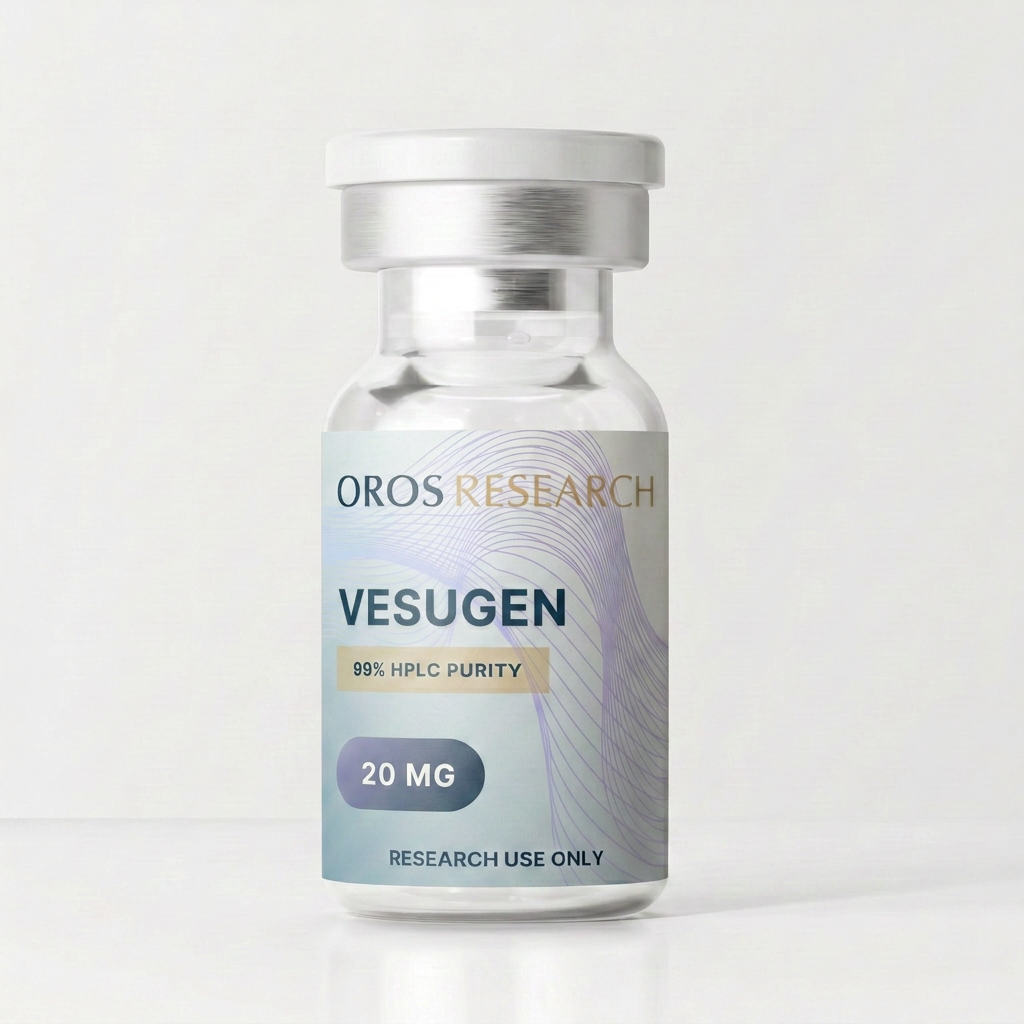
Vesugen 20mg
$49.99
- Compound: Vesugen 20mg
- Peptide sequence: H-Lys-Glu-Asp-OH (KED)
- Classification: Short-chain tripeptide research material
- Molecular Formula: C₁₅H₂₆N₄O₈
- Molecular Weight: 390.39 g/mol
- CAS Number: 204271-66-9
- Vial Size: 3 mL
- Intended Use: Strictly for controlled laboratory and in-vitro research; not for human or animal use
Vesugen 20mg – KED Peptide for Laboratory Research
Vesugen is a short-chain tripeptide research compound composed of the amino-acid sequence Lys-Glu-Asp, commonly abbreviated KED. This defined three-residue sequence has been investigated in experimental peptide research, including studies involving cellular regulation, vascular-associated experimental models, and short peptide biological activity.
OROS Research supplies Vesugen 20mg in a 3 mL vial for qualified laboratory investigation. Its compact KED sequence makes the compound relevant to researchers examining short peptide structure-function relationships, cellular responses, molecular interactions, and comparative peptide systems under controlled experimental conditions.
The compound should be regarded strictly as a research material. References to vascular biology or related experimental findings describe areas of scientific investigation and do not establish therapeutic effects or suitability for personal use.
Vesugen Research Overview
Vesugen is associated with the Lys-Glu-Asp sequence, also represented by the single-letter peptide sequence KED. Its small three-amino-acid structure distinguishes it from substantially longer research peptides and provides a defined molecular system for experimental investigations involving short peptide activity.
The supplied molecular formula is C₁₅H₂₆N₄O₈, with a molecular weight of 390.39 g/mol. Researchers can use the supplied PubChem CID reference alongside broader chemical information available through the PubChem chemical database when evaluating compound identity and related molecular information.
Scientific literature concerning short regulatory peptides can also be explored through the PubMed biomedical literature database. Published findings should be interpreted according to the specific experimental model, study design, and peptide form investigated rather than extrapolated directly to humans.
Vesugen Peptide and Experimental Research Context
The Vesugen peptide is principally relevant to research examining the biological behavior of short-chain peptides. The KED sequence has appeared in experimental literature concerning cellular processes and vascular-associated models.
One research area involves cellular and molecular responses associated with vascular tissue. Because of this research history, Vesugen is sometimes described using terms such as blood vessel bioregulator. However, that terminology should be understood as a research classification or proposed biological context rather than evidence of a clinically established vascular treatment.
Experimental work involving short peptides may examine parameters such as cellular responses, molecular signaling, peptide interactions, gene-expression-associated observations, or comparative activity across different peptide sequences. The results of such experiments depend heavily on the model and methodology used.
Laboratory Research Applications
Vesugen may be relevant to controlled research involving:
- Short peptide structure-function relationships
- Lys-Glu-Asp (KED) peptide characterization
- Cellular response studies
- Experimental vascular and endothelial models
- Comparative peptide research
- Molecular interaction studies
- Short peptide signaling investigations
- Analytical peptide characterization
Researchers investigating different peptide classes may also compare this material with Tesamorelin 16mg / Ipamorelin 4mg, which represents a distinctly different peptide research system.
OROS Research also provides Tesamorelin 5mg for qualified laboratory investigation. Researchers studying another short peptide research material may examine Testagen 20mg separately.
These products are chemically and experimentally distinct. Their inclusion as related research materials does not imply equivalent mechanisms, biological activity, or interchangeable experimental applications.
Vesugen Peptide Benefits in Laboratory Research
The phrase vesugen peptide benefits should be interpreted carefully when discussing this compound. Within a research setting, its practical value lies primarily in providing investigators with a defined KED tripeptide that can be evaluated in controlled experimental models.
Its three-residue structure allows researchers to investigate questions involving short peptide interactions, structure-activity relationships, and cellular responses without assuming that observations from experimental systems translate into clinical outcomes.
Research concerning vascular-associated models has contributed to the compound sometimes being categorized as a blood vessel bioregulator. This description reflects the proposed experimental context associated with the peptide and should not be interpreted as a demonstrated medical benefit, disease-treatment claim, or recommendation for human use.
Product Specifications
| Specification | Product Information |
|---|---|
| Product Name | Vesugen 20mg |
| Compound | Vesugen |
| Sequence | H-Lys-Glu-Asp-OH |
| Sequence Abbreviation | KED |
| Molecular Formula | C₁₅H₂₆N₄O₈ |
| Molecular Weight | 390.39 g/mol |
| CAS Number | 204271-66-9 |
| PubChem CID | 87571363 |
| Quantity | 20 mg |
| Vial Size | 3 mL |
| Classification | Tripeptide research material |
| Intended Use | Laboratory and in-vitro research only |
Vesugen Acetate and Compound Identity
Researchers searching for vesugen acetate should distinguish between the defined molecular identity of a peptide and any salt or formulation designation attached to a commercial research material. The specifications supplied for this OROS Research product identify the sequence as H-Lys-Glu-Asp-OH and provide the molecular formula C₁₅H₂₆N₄O₈.
No separate acetate specification is claimed for this product. Researchers should therefore rely on the stated product specifications when designing analytical comparisons rather than assuming that differently labeled Vesugen materials are chemically identical.
Vesugen FAQ
What is Vesugen?
Vesugen is a short tripeptide associated with the amino-acid sequence Lys-Glu-Asp, abbreviated KED. It is investigated as a laboratory research compound in studies involving short peptide biology, cellular responses, molecular interactions, and vascular-associated experimental systems.
What is the sequence of the Vesugen peptide?
The supplied sequence is H-Lys-Glu-Asp-OH, corresponding to the three amino acids lysine, glutamic acid, and aspartic acid. The sequence is commonly abbreviated KED and provides researchers with a compact peptide structure for controlled experimental investigation.
Why is Vesugen associated with vascular research?
Published experimental research involving KED has contributed to its investigation in vascular-associated and cellular models. This research context has led to descriptions such as blood vessel bioregulator. Such terminology represents an experimental research concept and should not be interpreted as proof of therapeutic vascular effects in humans.
What are the molecular specifications of Vesugen?
The supplied compound has a molecular formula of C₁₅H₂₆N₄O₈ and molecular weight of 390.39 g/mol. Its CAS number is 204271-66-9, and the supplied PubChem CID is 87571363. The peptide sequence is H-Lys-Glu-Asp-OH.
What quantity is supplied?
This OROS Research product contains Vesugen 20mg and is supplied in a 3 mL vial. The material is intended exclusively for qualified laboratory research and controlled experimental evaluation.
Is Vesugen acetate the same as this product?
An acetate form should not automatically be assumed to be identical to the specified compound. This product is identified using the supplied KED sequence and molecular specifications. No separate acetate specification has been provided for this material.
Is Vesugen intended for human use?
No. Vesugen supplied by OROS Research is intended strictly for laboratory and in-vitro research. It is not intended for human or animal consumption, administration, therapeutic application, diagnosis, treatment, or other personal use.
Research Use Disclaimer
Vesugen is supplied exclusively as a laboratory research material for qualified scientific investigation and in-vitro experimentation. It is not intended for human or animal consumption, clinical use, therapeutic application, diagnosis, self-administration, or veterinary use. Research personnel should evaluate the compound only within appropriately controlled laboratory environments and according to established institutional research procedures.
Related products

Reviews
There are no reviews yet.